"I cannot sleep unless I am surrounded by books."

Borges

Wednesday, October 05, 2005

Carry Me Like Water


This lush and touching novel by Benjamin Alire Saenz is simply astounding. The book is a story of interconnected stories of a most amazing cast of characters. There is the thoughtful and deaf Diego, living in El Paso, working on his suicide note and making friends with a cholo named Mundo whom he finds stabbed in a dumpster, Mary or the Virgin Mary and wise, irreverent Luz. There is Jake and Joaquin a gay couple struggling with Joaquin’s dying of AIDS, Helen and Eddy the rich couple in Northern California awaiting their first child and Lizzie, the nurse who one day while tending an AIDS patient, finds he was her twin brother, that he has given her his gift of being psychic and that she is really a Mexican named Maria de Lourdes. Each character is a puzzle waiting to be solved and amazing in their reality.

Each of these complex and tormented characters has their own story and each story dovetails neatly into one another into a rich and delicious stew of a novel. The book deals with AIDS, love, secrets and the ghosts of the past. We find that Helen is really Maria Elena or Nena and she is Diego’s sister. Eddy, her husband has his own past as a molested child to come to terms with and a brother to find. Jake is dealing with his anger and grief at losing Joaquin. And then there is my favorite character in the book, Lizzie. Lizzie can leave her body, she is coming to terms with her new found psychic ability and finds something in herself to give. She holds Jake and Joaquin together and becomes their anchor as they battle with illness and death.

The river too, is a large character in this book. It is the river in El Paso that separates Mexico from Texas. Diego and Luz spend Sunday mornings on the river watching the swimmers from the other side trying to cross over into a better life. The book deals with prejudice and hate, struggling to make a life in this land, gives an amazing view of what people give up to come here and what they find when they do.

Diego is thoughtful, reflective and kind. He speaks without speaking, says much in his thoughts and handwritten notes to Mundo or Luz. He is the heart of the book, the story within a story.

All in all, it is an amazing story, a commentary on life, on the issues that plague us today like border crossings, prejudice, AIDS, being Chicano, being gay, love, death and fear. The dialogue is crisp and interesting, each chapter seamlessly flows like the river into the next. It is poetic which is not surprising considering Saenz is an eloquent Chicano poet. Like his book, In Perfect Light, he has created a masterpiece of imagery, color and a unique and beautiful story revolving around a central theme.

Sunday, September 18, 2005

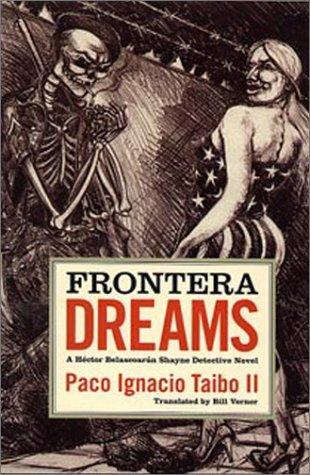
Frontera Dreams


If you haven’t yet read any of Paco Taibo’s Hector Beascoaran Shayne detective novels yet, be prepared for something wildly different than your usual detective fare. This is so much more than a mystery.

In Frontera Dreams, Hector is asked by the daughter of his old high school sweetheart now a big movie star, to track down her mother whom she feels is in danger. He leaves his Mexico City and heads out for the border looking for her. As he travels through the villages heading for the border, he travels through his memories as well. There is the reference to Tlateloco, the Mexico of the late 60’s and his memories of the sweetheart turned actress with the unlikely name of Natalia Smith-Corona.

The one-eyed, much scarred Shane battles with narcotraficantes, comtemplates the life these border people have, communes with the ghost of none other than Pancho Villa, recites and remembers poetry, hears the story of the 300 missing Zacatecas prostitutes and learns of the legend of the Chinese guy that jumped the fence of the US /Mexico border seven times in one day all the while doing his job finding Natalia.

Paco Ignacio Taibo, II is one of Mexico’s foremost writers. His character Shane has been knifed, scarred, wounded, killed – yes killed and resurrected by Taibo yet again. This story doesn’t have the feel of the other Shane novels, but those take place in Mexico City where the pace is different. Taibo captures the meandering crazy desperation of the border towns expertly in this literary and intense novel.

Thursday, September 01, 2005

Massacre in Mexico


Writing the review for Paco Ignacio Taibo’s book, “68 made me start thinking about another book I read years ago on Tlatelolco – Elena Poniatowska’s masterpiece entitled Massacre in Mexico. I went over to my shelf and pulled it down to re-read it. Wow! It still packs a punch and makes a deep impact.

Elena Poniatowska’s chronicle of the 1968 massacre at Tlatelolco is an astounding and must read book. An estimated 325 unarmed students were shot and bayoneted that night by Mexican police and Army troops in what had been a peaceful protest about the lack of political freedom and the one-party government. La Plaza de las Tres Culturas has been called Mexico’s Tianamen Square. The President at the time was Gustavo Diaz Ordaz.

Ms. Poniatowska calls it a “collage of voices bearing historical witness” and truly it is. The book is packed with first person accounts and interviews from witnesses, students and people anxiously looking for their children, wives, husbands and friends. In startling black and white photos, Poniatowska takes us there, back in time to that bloody October. There are photos of bodies lying in pools of blood, of police hauling students off to jail, of people crying, in agony, in despair.

Be prepared to cry, to rage, to be haunted for this is a brutally honest look at what happened in Mexico City that day. The voices beg out for justice, they ask why and they grieve. Some of the stories are just so heartbreaking that I have to stop, catch my breath and wipe my eyes.

Octavio Paz wrote the touching forward to this amazing chronicle. This is another must for any library, especially a Chicano one.

'68 by Paco Ignacio Taibo II


In the fall of 1968, 325 students were massacred by the Mexican police in the public square of Tlatelolco during a protest. One person I know who was there remembers running, running and slipping on the blood of his fellow students – agruesome memory that will haunt him all his life. In ’68, Paco Ignacio Taibo documents the student movement leading up to the bloody massacre.

In 1968, I was only seven years old and living here in Gringolandia, but I remember Tlatelolco. I remember my grandparents hearing the news from family in Mexico and grabbing me out of the living room to stay quietly with my tia in her room. Such things weren’t meant for little girls to hear. Being an overly curious child, I snuck out and eavesdropped when I could. I heard my grandparents crying over the news that came in slowly. I know now that there was a news blackout for some time. I remember my mother and my uncle whispering about it and of people they knew in Mexico, wondering if those people were some of the dead. I remember bits and pieces but I remember Tlateloco. Reading ’68 brought those bits and pieces to the front of my memories and filled in what I didn’t know.

The student movement was at one time a half million strong and led to a 123-day strike in high schools and colleges throughout Mexico. Mr. Taibo was one of that student movement and writes from his memory of nights spent painting buses, printing flyers, guarding the school. He talks of madness, the quest for freedom, of brutal police beatings, the disappearance of bodies, of his own near arrest, of friends who disappeared into prisons and his own feelings of guilt for not being in Tlatelolco at the time of the massacre. He puts faces onto the students and talks of friends in the Moviemiento.

There are chapters so haunting and atrocious that it becomes hard to read but too important, too absorbing to put down. Each chapter is evocative, telling and passionate. The chapters have titles like “Of Women and Mattresses, The Sound of Marching Feet, Wherein We Learn the Tanks Have Arrive, Throwing Corncobs and Even Liars Know the Truth”.

It is a chilling and enlightening view of the things that went on behind the scenes, from the student’s point of view in the months and years leading up to the Massacre that some of us know so little of. The Mexican government covered up much of what happened and even now all these years later, information is not clear. Paco Ignacio Taibo II does much to uncover what remains hidden.

He asks, “Where did they throw our dead? Where did they toss our dead? Where, for fuck’s sake, did they throw our dead?” We should be asking the same.

Seven Stories Press has this title available in both English and Spanish along with other important books. Please visit and support this publisher.

Modelo Antiguo


This book was another great find from one of my favorite publishers Cinco Puntos Press. The translation into English by Sharon Franco and Joe Hayes is smooth, catching all the Mexican dialogue and chistes with ease. Cinco Puntos is doing such a fantastic job in bringing over these great Mexican novels by writers like Luis Eduardo Reyes and Paco Taibo II that before I write my review on the book, I have to take a moment to thank them and encourage them in this wonderful task they are undertaking.

The novel centers on Juan, a young taxi driver and Barbara, a 74 year old virgin who wants to die in her vintage, cherry old Ford and so hires Juan as a chauffeur to drive her around Mexico City – the Mexico City that she remembers from her youth. It’s a wild ride through the streets of the city and the reader is made familiar with these crazy Mexican streets.

Barbara is a well-bred lady and Juan, a rude, crude and not so honest man. They start off hating each other. Juan’s nefarious intentions are to steal the car and whatever money he can get from Barbara but something keeps bringing him back on this strange ride through Barbara’s memories and the city streets. Slowly they begin to fall for each other and this strange romance ensues as they dodge danger, visit hotels and pharmacies as they try to deal with their feelings and emotions.

It’s a funny, wry, absurd and wonderfully surreal tale of Mexico City and love.

Monday, August 29, 2005

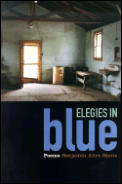
Elegies in Blue


From my dictionary's defintion for elegy:
French élégie, from Latin elega, from Greek elegeia, from pl. of elegeion, elegiac distich, from elegos, song, mournful song.

This third book of poetry (and some prose) by Chicano poet, Benjamin Alire Sáenz is remarkable, beautiful and mournful. It is an astounding, touching and reflective look at life on the El Paso border told by someone who was born and raised there. The book is also an homage to people, from the infamous like Pancho Villa, to Cesar Chavez, to the author’s father-in-law to JFK.

All the work bears the lyrical stamp of Mr. Sáenz. He has a special knack for creating the most simple and beautiful lines on a page. I always find myself stopping to read a certain passage, a stanza again, to read it aloud just to be swept away by the sheer grace and raw power of it. Take for instance this section in his poem What Was It All For Anyway, Cesar Chavez?

“Flattering strategy. You wore that word out Injustice.
It made you sound accusing and superior. Not smart
Cesar, people got nervous. People hated you
Because you spelled it out – one lettuce
At a time.”

In the prose-like American Camps, he speaks eloquently of a boy in a picture he finds in a library, a boy with intelligent eyes, behind barbed wire. He speaks of the hidden histories, obscure ethnic histories.

I loved the poem At the Grave of Pancho Villa. I especially loved the line

“Well better bullets than cancer
for a General.”

My favorite of all the poems and to me, the most strikingly elegiac was The Blue I Loved. It was truly a lovely and haunting in its warm and vibrant imagery.

The poetry in this book is filled with rage, indignation, pride, community, righteous anger and political voice. Any Chicano worth his salt should run over to Cinco Punto’s website and buy it. Don’t just buy it – read it, feel it, love it and then read it again and again.

BlogBurst.com