"I cannot sleep unless I am surrounded by books."

Borges

Showing posts with label fiction. Show all posts

Saturday, November 03, 2007

Fred Patten Reviews The Game


The Game
Author: Diana Wynne Jones
Publisher: Firebird/Penguin Group
ISBN: 10: 0-14-240718-6
ISBN: 13: 978-0-14-240718-9

Hayley is a young girl living in London with her grandparents since her parents disappeared when she was a baby. Her overly strict grandmother keeps her virtually a prisoner at home, especially denying her knowledge of the mysteriously beautiful “mythosphere” which her grandfather studies on his computers. Finally she is banished in disgrace (but without being told why) to the home of relatives in Ireland.

Glumly expecting an even harsher household, Hayley is pleasantly bewildered to find that “the Castle” is a lively place overflowing with friendly aunts and young cousins her own age who seem to have been expecting her for ages.

The children eagerly introduce her into their secret game, a scavenger hunt for objects like a scale from the dragon that circles the zodiac, Sleeping Beauty’s spindle, a drinking horn used by Beowulf, and a hair from Prester John’s beard. Since Hayley has grown up uneducated, she does not realize how rare these are; but she is delighted when the search takes them into the forbidden mythosphere:

“They could see the strand they were on now, a silvery, slithery path, coiling away up ahead. The worst part, to Hayley’s mind, was the way it didn’t seem to be fastened to anything at the sides. Her feet, in their one pink boot and one black boot, kept slipping. She was quite afraid that she was going to pitch off the edge. It was like trying to climb a strip of tinsel. She hung on hard to Troy’s warmer, larger hand and wished it were not so cold. The deep chilliness made the scrapes on the front of her ache.

To take her mind off it, she stared around. The rest of the mythosphere was coming into view overhead and far away, in dim, feathery streaks. Some parts of it were starry swirls, like the Milky Way, only white, green, and pale pink, and other more distant parts flickered and waved like curtains of light blowing in the wind. Hayley found her chest filling with great admiring breaths at its beauty, and she stared and stared as more and more streaks and strands came into view.”


It is obvious almost from the start that Hayley is a special child. Just how special is revealed slowly as the story progresses and Hayley learns who she and her parents really are. Jones has used the plot device of walking between worlds in previous novels, but The Game is separate from her other books.

A knowledge of Greek and Roman mythology may help the reader recognize some of the characters whom Hayley does not know, but Jones introduces them all in a curtain-call endnote. This short novel or novella is in the Firebird series for young readers, although it, like Jones’ other novels, will charm readers of all ages.

Sunday, July 01, 2007

Reviewing the Classics of Kidlit - Elizabeth Lund reviews Cloudy with a Chance of Meatballs


Cloudy With a Chance of Meatballs by Judi Barrett, illustrated by Ron Barrett

By turns silly, funny, and scary, but always imaginative, Cloudy With a Chance of Meatballs, originally published in 1978, has achieved the status of a classic. This book has a very simple plot, but the detailed drawings and the unique idea of food falling from the sky make it a perennial winner with kids.

One morning at breakfast, a pancake is accidentally flipped onto a young boy’s head. Later, his grandfather uses this incident as inspiration for a bedtime tall tale. He begins by playing with the phrasing and style of television weather reports to describe the town of Chewandswallow and its very unusual weather. At first, the idea of food falling from the sky and carrying dishes around everywhere seems fun. Much of the food is even kid-friendly—the ordinary weather of Chewandswallow includes hamburgers, pancakes, fried chicken, pie, and hot dogs. In just a few pages, Judi and Ron Barrett create a charming and surprisingly logical mini-society, even describing the town’s environmentally responsible ways of dealing with leftovers.

When the weather starts to change, the story becomes a true tall tale. First, Chewandswallow gets unappealing foods like Gorgonzola cheese and overcooked broccoli. My favorite drawing in this book has always been the picture of an unfortunate birthday party where the cake is made out of peanut butter, brussel sprouts, and mayonnaise. The expression on the face of the girl in the foreground of this picture is a perfect depiction of the disgust of a kid who doesn’t like what she’s being served. Then, the weather turns dangerous, with enormous pancakes, bread hurricanes, and tomato tornadoes. (While the townspeople certainly appear annoyed, no one seems hurt, keeping the book appropriate for younger children.)

Like the movie version of The Wizard of Oz, the real world is pictured in black and white and the imaginary world is pictured in color. The overlaid text and the use of panels give it an almost graphic novel feel.
Details like plates stacked in a coat closet, a couple fighting over a hog dog, and a baseball marquee reading “Game Called on Account of Pie,” keep children looking closely at every illustration. Ron Barrett’s unique style of line drawing captures both domestic settings and almost epic landscapes equally well. A few of the drawings have a definite 1970s flavor, which may invite discussions about what Mom, Dad, or Uncle Harry looked like when they were little.

This light and charming story is almost guaranteed to make readers hungry.

Thursday, June 14, 2007

Memoirs of a Teenage Amnesiac


Memoirs of a Teenage Amnesiac
Author: Gabrielle Zevin
Publisher: Farrar, Straus and Giroux
ISBN-10: 0374349460
ISBN-13: 978-0374349462

When 17-year old Naomi takes a tumble down the steps one evening, she wakes without the past four years of her memory and holding on to a cute boy she knows nothing about. They get to know each other in the ambulance ride to the hospital.

Naomi slowly starts to put her life together but there are so many things wrong with it. Like why can’t she remember Will, her best friend and co-chief editor of the school yearbook? She can’t remember that her parents are divorced or that she has a sister. Why can’t she remember ever kissing her boyfriend Ace? Matter of fact, she doesn’t even remember him. She reads her journal and doesn’t recognize her writing or her thoughts. Is she really this obsessed with how many calories she takes in each day? There has to be more to her than this.

Memoirs of a Teenage Amnesiac is a fantastic story. It’s Naomi’s journey of self-discovery, of finding out just who she really is and what defines her as a person. It’s a second chance. As we get to know Naomi and her life, we’re completely involved, cheering her on, booing the bad decisions, stopping to take in her confusion and the realization that even with her memory back she’d be a changed person. She has a chance to choose the life she wants over the life she had before her accident. How great is that?

The author of that marvelously quirky and different novel Elsewhere really shines with this one. The book is well written, the characters so real we feel we know them and the story is completely original and fresh. Highly recommended!


Book Description from the publisher:
If Naomi had picked tails, she would have won the coin toss. She wouldn’t have had to go back for the yearbook camera, and she wouldn’t have hit her head on the steps. She wouldn’t have woken up in an ambulance with amnesia. She certainly would have remembered her boyfriend, Ace. She might even have remembered why she fell in love with him in the first place. She would understand why her best friend, Will, keeps calling her “Chief.” She’d know about her mom’s new family. She’d know about her dad’s fiancée. She never would have met James, the boy with the questionable past and the even fuzzier future, who tells her he once wanted to kiss her. She wouldn’t have wanted to kiss him back.

But Naomi picked heads.

After her remarkable debut, Gabrielle Zevin has crafted an imaginative second novel all about love and second chances.


About the Author
GABRIELLE ZEVIN’s first young adult novel, Elsewhere, was an ALA Notable Book and a Quill Book Award nominee. Of her writing, The New York Times Book Review said, “Zevin’s touch is marvelously light even as she considers profundities.” She lives in New York City.

Friday, May 18, 2007

The Virgin’s Guide to Mexico


The Virgin’s Guide to Mexio
Author: Eric B. Martin

Publisher: MacAdam/Cage

ISBN-10: 1596922109

ISBN-13: 978-1596922105


The Virgin’s Guide to Mexico
is a compelling tale of a young girl and her search for identity. Alma, a bright but homely student who is nothing like her beautiful, Mexican mother decides to take a year off after being accepted into Harvard. She plans to go to Spain but her parents don’t allow it so she’s stuck in Texas having to go to the local college for a year.

Alma finds some letters of her mothers from a grandfather she never knew she had that lives in Mexico. Curious as to why her mother never speaks of her life in Mexico and having that typical teenage disdain for her parents, she runs away to find her grandfather and the secrets her mother hides.
Alma hopes that Mexico will welcome her. She has a vision of Mexico as something out of a dream, a warm and welcoming place. She’ll find her grandfather and somehow, everything will be better.

Alma’s first foray into Mexico is frightening so she heads back into the US, disguises herself as a boy and attaches herself to a group of guys heading over the border.

Through Alma’s eyes we find out about the true Mexico, not the beautiful imagined dream. There are strange characters and unsavory ones, a strange old man who lives in a shack filled with beautiful paintings and the guys she hangs out with. The underbelly of Mexico is exposed with visits to whorehouses, bars and parties. Underneath the beautifully written prose is this dark hint of menace throughout. It’s a little unsettling and keeps you riveted to the page.

Alma’s quest alternates with that of her parent’s to find her. Her beautiful mother wonders what she did wrong, while her dot com rich father is determined to find her.

Eric B. Martin weaves a multi-dimensional and emotional tale of love, secrets, misunderstandings and modern Mexico. He sheds light on the tremendous poverty and challenges facing Mexico and it’s people. Martin also manages to show the shimmer of brilliance and beauty, the glory that was once Mexico and at times still is.


Thursday, May 10, 2007

Tales from the Farm


Essex County Vol 1: Tales from the Farm
Author: Jeff Lemire
Publisher: Top Shelf Comics
ISBN-10: 1891830880
ISBN-13: 978-1891830884

Xeric Award-winning cartoonist Jeff Lemire (Lost Dogs) brings a lonely Ontario farm brilliantly to life in this wonderful graphic novel.

Lester, a young orphan is living on this vast and lonely place with his Uncle Ken, a bachelor who clearly has no idea what to do with the boy. Lester continually wears a cape and mask and wanders the farm imagining that he is watching for aliens. His uncle doesn’t understand him but desperately wants to build some kind of relationship with him. He invites him to watch hockey games on television, but Lester avoids it and sits in his room along watching the same game. It’s heartbreaking.

One day Lester runs into Jimmy Lebeuf, gas station attendant and damaged ex-hockey star. Jimmy doesn’t think Lester is strange for wearing his cape and mask and he completely believes in the possibility of an imminent alien invasion. The two bond and slowly Lester starts to come to life. Uncle Ken finds out and is clearly upset at the two’s connection. Flashbacks to Lester’s mother dying of cancer give the story added depth and insight into Lester’s and Jimmy’s connection.

Tales from the Farm
is illustrated in sparse, blocky yet amazingly detailed drawings that are imbued with so much emotion and a spare, raw beauty. Each page is a delight and so much is conveyed without words. The strain and miscommunication between Lester and Uncle Ken is written on their faces as clearly as if a whole chapter had been written in text. It’s beautiful and so well done.

Sunday, May 06, 2007

The Mark Of The Horse Lord


The Mark of the Horse Lord
Author: Rosemary Sutcliff
Publisher: Front Street; 1 Reprint edition (February 2, 2006).
ISBN-10: 1932425624
ISBN-13: 978-1932425628

The Plot: Phaedrus is a gladiator in second century Britain; a bloody, violent fight to the death in the arena results in Phaedrus killing his best friend, winning his freedom, and having no idea what to do next. What does a slave know about living as a free man?

Phaedrus is approached with a scheme involving the tribes to the North, in Scotland; the king died seven years ago. His son, Midir, went missing; and Levin's half-sister, Liadhan, seized the opportunity to bring back goddess worship and set herself on the throne.

The thing is, Phaedrus looks exactly like the missing Midir. Why not put him on the throne instead, and remove Liadhan from power? So Phaedrus pretends to be Midir -- pretends to be King -- and gets more than he bargained for as he begins to realize what it means to be a King.

The Good: Non stop action. Chapter One, we get a mother's suicide, gladiator fights, freedom; Chapter Two, a drunk night on the town resulting in fights, stabbings, and fire; Chapter Three is prison and the Midir plan. There's barely a place for Phaedrus or the reader to breathe. Yet, within all that action, Sutcliff includes many details about the second century Britain.

Once Phaedrus agrees to the plan, there's a lot he has to learn. And he keeps finding out that that there is even more involved than he thought.

Since this was written in 1965, I was a bit concerned about how the goddess religion would be treated. To be simplistic, it seems like all books about it written before a certain time depict it as Evil; and all written after a certain time depict it as The Golden Age. Silly me; Sutcliff does almost the impossible by making no modern judgments. Yes, the faction that Phaedrus sides with wants the sun centered god religion, rather than the moon centered goddess; and the goddess religion shown involves human sacrifice. But it's done rather evenhandedly; and the religion dispute is more a side issue, with the real dispute being about power, and who has it.

What else? There's a map! I love maps; and a brief historical note intro, letting the reader know a bit of the historical context and clearly stating that this is fiction, but here's the true history part.

As for the true history part, I love that Sutcliff looks at a bit of history that does not get much written about it. Seriously, how many other books sent in second century Scotland are there are about the Dalriad?

The brutality of the time is genuinely shown; what really happened to Midir, for example. My clues; he's alive; and remember, that a maimed man could not be king. If you don't want to murder a child but do want to make sure he never becomes king, what do you do?

Age: I think today, this would be a YA book or an adult book. Phaedrus is about nineteen; there are wars, bloody battles, even a bit of a romance. Part of what Phaedrus has to face is the difference between the best choice for himself; and the best choice for his people. But are they his people -- isn't he just pretending to be King?

The cover: isn't that cover great? I read the original hardcover, boring black, but there is a mark on the cover that is supposed to be the mark of the horse lord that Phaedrus gets tattooed on his forehead.

Quotes: "[Essylt, Phaedrus's mother] had used the slim native hunting dagger that had served Ulixes as a papyrus knife; but there was not much blood because she had stabbed herself under the breast, not cut her wrists as a Roman woman would have done." In one sentence, Sutcliff tells us how Phaedrus's mother killed herself, also revealing how the native / Roman cultures mixed yet did not mix.

On fighting to the death as a gladiator: "Like the sudden opening of a cavern in his head, reality burnt upon Phaedrus, and in that ice-bright splinter of time he understood at last that this was a fight to the death, that he was fighting, not his comrade Vortimax, whom he had fought scores and hundreds of times before, but death -- red rending death such as the stag's had been, and the hooks of the mercuries in the dark alleyway." Again, awesome detail; and lovely how Sutcliff creates a world where you "know" what it is those mercuries do without her ever really saying.

While I liked how Sutcliff had the opening note, I would have loved to have the titles of her actual source material. I wonder if the marriage ceremony shown is accurate, and the same for the Women's War Dance.

Finally? Amazing, amazing ending. Entirely true to the book and the characters, yet still unbelievable and almost shattering.

Now all I want to do is read all of Sutcliff's other books.

Links:
Wikipedia article on the Dál Riata
Interview with Rosemary Sutcliff
Rosemary Sutcliff: An Appreciation blog, with The Mark of the Horse Lord review
Teacher Resource File for Sutcliff
Rosemary Sutcliff: blog by godson (here, also)
I Speak of Dreams blog review
1985 Phoenix Award Winner

Friday, April 27, 2007

Reviewing the Classics of Kidlit - The Mixed-Up Files of Mrs. Basil E. Frankweiler - Reviewed by Elizabeth Lund


The Mixed-Up Files of Mrs. Basil E. Frankweiler
Author: E.L. Konisburg
Publisher: Atheneum
ISBN-10: 068985322X
ISBN-13: 978-0689853227


When I reread The Mixed-Up Files, I can hardly believe it was written in 1968. Though the amount of Claudia's allowance and the price of The New York Times reveal its age, few books from that era retain such a contemporary feel.

For those who aren't familiar with the book, The Mixed-Up Files is about Claudia and Jamie Kinkaid, two suburban siblings who, fed up with the rest of their family, run away to The Metropolitan Museum of Art. The adventure becomes a mystery when they become determined to discover the true origin of a statue named angel, reputed to be the work of Michelangelo. Claudia's careful planning makes their escape and survival plausible. Jamie's practical nature and eye-rolling attitude keep Claudia from getting too romantic. The siblings complement each other and form a partnership that is at first grudging, later affectionate, making this a book with both boy and girl appeal.

I still think this is a nearly perfect premise for a middle-grade novel. It may not grab immediate attention, but in its simple plot, there are elements to appeal to many different segments of child readers: mystery lovers, kids intrigued by the romance of big cities, kids who like art and museums (such kids exist; I was one of them), and the nearly universal appeal of a story about running away.

And yet The Mixed-Up Files is so much more than its plot. Konigsburg works philosophy into these pages: ideas about secrets, learning, our need for comfort, and the isolation of modern life. Most importantly, she explore what make someone an individual rather than a member of a school class, a member of a family, or someone who defined simply by the motions of their daily lives.

Each detail in The Mixed Up Files is carved as carefully as Michelangelo's fictional angel. I remember precisely such images as the strip of white flesh between Jamie's jacket and sagging trousers when he fills his pockets with change, the deep black tub with golden faucets, the meals they eat from the Automat. The language is equally thoughtful. Decades after I first read this book, sentences such as, "Bedtime is the worst time for organized thinking," still ring in my mind.

Far from being outdated, The Mixed Up Files becomes increasingly relevant. Jamie and Claudia are described as siblings who were so busy with activities that they never really spent much time together, a situation that is certainly even more common today than in the sixties. They're suburban. They're consumers, with Claudia's spending of her paltry allowance described as "her biggest adventure each week." And they feel the emptiness of their busy lives. That is why they run away—as Claudia puts it, to "come back different."

By the end, she is different, and so are we.

Tuesday, April 24, 2007

Cecilia's Year


Cecilia’s Year
Author: Susan Gonzales Abram and Denise Gonzales Abram
Publisher: Cinco Puntos Press
ISBN-10: 1933693029
ISBN-13: 978-1933693026

Cecilia’s Year covers the life of a 14 year old Mexican-American girl who lives on a ranch in New Mexico during the Depression era.

Cecilia is smart, bookish and determined in her quiet way to follow her dreams. One of those dreams is going to high school instead of marrying and being a stay at home wife and mother as is expected of girls in that era. The book is set up with each chapter dedicated to a different month on the ranch with rich cultural details and a profound sense of community. The family and friends Cecilia has surrounding her are all very definite personalities and each feels real and true.

Cecilia’s Year has a down home feel to it with a strong Mexican flavor. Even though I grew up decades after Cecilia did and in the city, most of the core values, the family she lives with, the dichos (sayings) and food they eat is much like what I grew up with in my Mexican home. Some things always remain the same. The book really resonated with me for those reasons as well as being a great and engrossing story. You just have to love Cecilia and root for her. You hope she gets everything she dreams of and that’s the magic of reading a book like this – you end up really caring about the characters. They become real to you. Cecilia’s story is heartfelt and lovely.

The book is a tribute to the author’s mother and a note at the end tells what happened to the real Cecilia. Sepia toned photos are included as well as a glossary of Spanish dichos.

Saturday, April 07, 2007

The Lighthouse Land


The Lighthouse Land
Author: Adrian McKinty
Publisher: Amulet Books
ISBN-10: 081095480X
ISBN-13: 978-0810954809

Jamie O’Neill and his mother have it rough. Jamie’s lost his arm to bone cancer and since the amputation isn’t speaking. His parents divorced while he was sick and now he and his mother live in a leaky apartment in Harlem. Things couldn’t get much worse for them but somehow Jamie and his mom are making things work.

Jamie has a friend, Thaddeus an older gentleman that he plays chess with who seems to understand his need to be silent. He’s also become quite adept at duct taping the windows to keep the snow out. Then one day a letter changes their lives. Jamie’s mother has inherited a house in Ireland along with the island it’s on and money to maintain it.

So off they go to Ireland and Thaddeus gifts him with a tablet laptop to help him communicate. Once they get to the coast of Ireland and their new home, they find that there’s also an old tower, a lighthouse on their land and that Jaime is descended from a line of Irish kings. Turns out Jamie gets a title as well, Laid Ui Neill, Lord of the Muck, Guardian of the Passage…yeah, Lord of the Muck. I thought that was hysterical.

Jamie quickly makes friends with Ramsey, a clever and mathematically brilliant boy of his own age. Together they discover a secret room in the tower and an object that takes them hurtling through a portal and into another world where they find an alien girl named Wishaway. Wishaway thinks that Jamie is the Ui Neill come to save her people from the Alkhavans, an evil pirating people who will enslave her race.

The Alkhavans travel the seas on ships made of ice that look like glaciers. It turns out that Jamie’s ancestors had saved her people before. Jamie. mysteriously in this world has both his voice and his lost arm. Now it is up to him and Ramsay to save the world and its people from destruction.

The Lighthouse Land is an astonishing tale of fantasy, sci-fi and ordinary life. I fell in love with McKinty’s writing from the very first two paragraphs. I fell in love with his way of writing a sentence. His use of language is gorgeous and lush while starkly simple.

“Through the window is the uncoiled arm of the Milky Way and the moon the color of narcissus.”

Isn’t that a great sentence? I can eat it, it’s so delicious!

The Lighthouse Land
is the first in a planned trilogy and I for one, can’t wait till the next.

About the author:
Adrian McKinty, now a U.S. citizen, was born and grew up in Carrickfergus, Northern Ireland. Educated at Oxford University, he then immigrated to New York City, where he lived in Harlem for five years, working in bars and on construction crews, and enjoying a stint as a bookseller. The author of highly acclaimed crime novels that have earned starred reviews and universal praise, he currently lives in Denver, where he teaches high school.

Wednesday, April 04, 2007

Fred Patten Reviews The Pinhoe Egg


The Pinhoe Egg: A Chrestomanci Book
Author: Diana Wynne Jones
Publisher: Greenwillow Books/HarperCollins
ISBN10: 0-06-113124-5
ISBN13: 978-0-06-113124-0

The Pinhoe Egg adds a sixth novel to Jones’ witty Young Adult tales of Chrestomanci, the debonair and unflappable super-enchanter who is a government employee in a Related World where magic exists. It takes place about a year after the events in Charmed Life (1977).

The Pinhoe Egg is set in Chrestomanci Castle and the nearby village of Ulverscote. As is common in centuries-old English small villages, one family has come to predominate. Practically everyone in Ulverscote is a Pinhoe or is married to a Pinhoe. The same situation exists in neighboring Helm St. Mary where the dominant family is the Farleighs.

The adult Pinhoes and the Farleighs are all wizards and witches to some degree, overseen by a male Gaffer and a female Gammer who are the most powerful magicians in their clans, but trying to keep a low profile living so close to Chrestomanci.

The main characters are four pre-teens; Marianne and Joe Pinhoe in Ulverscote, and Eric (Cat) Chant and Chrestomanci’s son Roger who live in the Castle. Marianne is an observer when Gammer Edith, the ancient Pinhoe matriarch, loses her wits and has to be gently locked away.

Unfortunately, she has not lost any of her powers, and she begins casting spells against the Farleighs whom she has never liked. The Farleighs, assuming that all the Pinhoes are attacking them, retaliate. Gammer Edith has previously bespelled the other Pinhoes to keep them from noticing her misuse of magic. Marianne grows increasingly frustrated as her parents and all her uncles and aunts and cousins refuse to believe that their plagues of frogs and other disasters are due to anything more than natural causes.

As the curses grow increasingly life-threatening, Marianne tries to get help from the Castle, but Joe and Roger are too busy inventing magical machines, while Cat is distracted by learning to care for a semi-magical horse, Syracuse, and the baby griffin that hatches from the strange egg that Marianne innocently gives him. Much more is going on at the same time, including some deliberately malicious spellcasting, and it all escalates into a potentially lethal magical muddle (not unlike the Sorcerer’s Apprentice’s situation) before Chrestomanci steps forth to put things right and strip the powers from those who have misused their magic.

Those who have read Charmed Life will recognize many of the supporting characters, but The Pinhoe Egg stands nicely on its own as a humorous fantasy-mystery. The old-fashioned English village setting should be attractively exotic to American readers.

Wednesday, October 05, 2005

Carry Me Like Water


This lush and touching novel by Benjamin Alire Saenz is simply astounding. The book is a story of interconnected stories of a most amazing cast of characters. There is the thoughtful and deaf Diego, living in El Paso, working on his suicide note and making friends with a cholo named Mundo whom he finds stabbed in a dumpster, Mary or the Virgin Mary and wise, irreverent Luz. There is Jake and Joaquin a gay couple struggling with Joaquin’s dying of AIDS, Helen and Eddy the rich couple in Northern California awaiting their first child and Lizzie, the nurse who one day while tending an AIDS patient, finds he was her twin brother, that he has given her his gift of being psychic and that she is really a Mexican named Maria de Lourdes. Each character is a puzzle waiting to be solved and amazing in their reality.

Each of these complex and tormented characters has their own story and each story dovetails neatly into one another into a rich and delicious stew of a novel. The book deals with AIDS, love, secrets and the ghosts of the past. We find that Helen is really Maria Elena or Nena and she is Diego’s sister. Eddy, her husband has his own past as a molested child to come to terms with and a brother to find. Jake is dealing with his anger and grief at losing Joaquin. And then there is my favorite character in the book, Lizzie. Lizzie can leave her body, she is coming to terms with her new found psychic ability and finds something in herself to give. She holds Jake and Joaquin together and becomes their anchor as they battle with illness and death.

The river too, is a large character in this book. It is the river in El Paso that separates Mexico from Texas. Diego and Luz spend Sunday mornings on the river watching the swimmers from the other side trying to cross over into a better life. The book deals with prejudice and hate, struggling to make a life in this land, gives an amazing view of what people give up to come here and what they find when they do.

Diego is thoughtful, reflective and kind. He speaks without speaking, says much in his thoughts and handwritten notes to Mundo or Luz. He is the heart of the book, the story within a story.

All in all, it is an amazing story, a commentary on life, on the issues that plague us today like border crossings, prejudice, AIDS, being Chicano, being gay, love, death and fear. The dialogue is crisp and interesting, each chapter seamlessly flows like the river into the next. It is poetic which is not surprising considering Saenz is an eloquent Chicano poet. Like his book, In Perfect Light, he has created a masterpiece of imagery, color and a unique and beautiful story revolving around a central theme.

Sunday, September 18, 2005

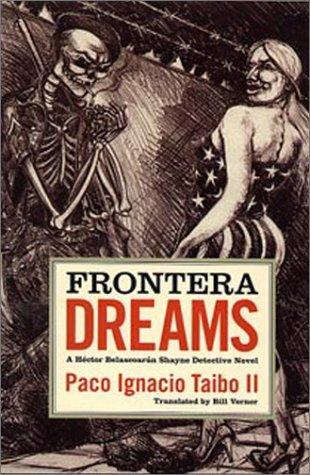
Frontera Dreams


If you haven’t yet read any of Paco Taibo’s Hector Beascoaran Shayne detective novels yet, be prepared for something wildly different than your usual detective fare. This is so much more than a mystery.

In Frontera Dreams, Hector is asked by the daughter of his old high school sweetheart now a big movie star, to track down her mother whom she feels is in danger. He leaves his Mexico City and heads out for the border looking for her. As he travels through the villages heading for the border, he travels through his memories as well. There is the reference to Tlateloco, the Mexico of the late 60’s and his memories of the sweetheart turned actress with the unlikely name of Natalia Smith-Corona.

The one-eyed, much scarred Shane battles with narcotraficantes, comtemplates the life these border people have, communes with the ghost of none other than Pancho Villa, recites and remembers poetry, hears the story of the 300 missing Zacatecas prostitutes and learns of the legend of the Chinese guy that jumped the fence of the US /Mexico border seven times in one day all the while doing his job finding Natalia.

Paco Ignacio Taibo, II is one of Mexico’s foremost writers. His character Shane has been knifed, scarred, wounded, killed – yes killed and resurrected by Taibo yet again. This story doesn’t have the feel of the other Shane novels, but those take place in Mexico City where the pace is different. Taibo captures the meandering crazy desperation of the border towns expertly in this literary and intense novel.

Saturday, August 27, 2005

The Moon Will Forever Be a Distant Love

“AMID THE MARKETS AND CANALS of the great city of Mexico-Tenochtitlan, smack on the corner where nowadays Dolores Street runs past the Chinese restaurants and umbrella stores, Conquistador Balboa is in a rush to run an errand for the Marquis, and the Indian girl Florinda is walking to the flea market.”

This is the first sentence in this marvelous, surreal novel by Luis Humberto Crosthwaite, one of Mexico’s well-known novelists and Cinco Puntos Press has done a marvelous thing in bringing this author’s work to the US for us to enjoy.

The book is about Florinda and her Conquistador love, Balboa who is fired from his bureaucratic job with the other conquistadores because of downsizing. The two leave to Tijuana by bus hoping to cross The Border into the Northernish Empire.

As with many couples, real life intrudes on their fairy tale. They find without the proper papers they cannot cross The Border, Florinda (Xochitl) has to live with Balboa’s lisping Castillian family who treat her like a maid. Meanwhile Balboa’s uncle gets him across the border stuffed into the trunk of a car while still wearing his conquistador armor.

In this bizarre and wonderful quirky novel, centuries are traversed and lives change. Florinda comes to work in a factory in Tijuana, becomes a serious shoe-aholic and learns to live on her own. Balboa starts wearing jeans and a t-shirt, loses his lisp and takes up with the fair haired waitress Maryanne before getting rounded up by La Migra. This is such a fun and well told story filled with chistes and puns. I think my favorite part was when the Conquistador gets picked up by La Migra and deported. I encourage everyone to read this book and to find more Crosthwaite in his native Spanish. Kudos to Cinco Puntos for bringing him to the light here in the Northernish Empire!

Sunday, July 24, 2005

Enchantment


Enchantment is the story of a modern day Jewish Ukranian boy who stumbles upon a sleeping young woman covered by a lake of leaves while on an extended visit to a cousin’s farm. The boy ends up leaving to America with his parents, his father a professor of some note and his mother, a mysterious and loving woman.

The boy grows to manhood in America, a scholar like his father with a love of running. He loves running and while his parents find it strange, he finds it suits him and joins track and field. He is haunted though by his dreams of the young woman sleeping in the forest and embarks on a trip back to the Ukraine to work on his thesis of folk tales.

He returns to his cousin’s farm and one day goes to where he believes he dreamed the young beauty sleeping in the forest. To his surprise he finds her and battles a bear to get to her. It is Sleeping Beauty and he wakes her with a kiss and a promise of marriage even though he is engaged and has left his fiancée behind in America.

What follows is a remarkable tale in which Ivan and his princess travel back in time to old Russia and battle Baba Yaga herself. It is a charming and stunning re-telling of an old fairy tale. I was completely entranced by this spell binding tale and quite surprised even though I am a long time fan of Orson Scott Card. I encourage everyone to read this incredible tale which mixes magic, time travel, folk tales and modernity. If you’re a fan of Orson Scott Card you’ll love it and if you’ve never read him, this is the book to start with.

Saturday, June 25, 2005

Zorro


When I first heard Isabel Allende had written a novel about Zorro, I went crazy with excitement. Ms. Allende is one of my favorite authors and Zorro, one of my favorite and beloved characters. What a pairing! I wasn’t disappointed. Allende’s Zorro is wonderful.

Told from the point of view of a close friend of Zorro’s aka Don Diego de la Vega, the novel tells of Zorro’s origins from his birth to his time in Spain to his return to California. Diego is born to Don Alejandro de la Vega and Regina, a mestizo whose real name is Topurnia. The character of Regina is fascinating, she is herself a warrior, chosen by wolves and she meets Don Alejandro while storming the very mission he is there to defend. She teaches the young Diego the language of her people and takes him without her husband knowing to the Indian village where he learns of her people’s ways and traditions.

Ms. Allende’s storytelling leaves no detail unturned, we meet Diego’s milk brother Bernardo and learn of their strong bond of friendship, and we travel to Spain, a Spain during the Napoleonic era. Diego is wonderfully complex in learning to live with his duality both as Diego/Zorro and as a Spanish hidalgo/indigenous man. His concept of honor is developed early, his love for his mother’s people is deep, and his horror at the way the Dons treat indigenous people is captured perfectly by the author.

We learn of his instruction in swordsmanship by the famed Escalante, which eventually leads to the joining of a secret society. There is intrigue, travel, romance, and betrayal. We even get to meet the famed pirate Jean Lafitte.

Isabel Allende offers a fresh, action-packed new dimension to her Zorro and he crackles with his new life in this fantastic and swashbuckling novel.

Saturday, June 11, 2005

Loving Pedro Infante

“If you’re Mejicana or Mejicano and don’t know who Pedro Infante is, you should be tied to a hot stove with yucca rope and beaten with sharp dry corn husks as you stand in a vat of soggy fideos”

- Denise Chavez (Loving Pedro Infante)


Okay, I just had to start my review off with that passage because when I read it, I laughed aloud. It is just such a typical Xicano, Mejicano curse that I’m sure we’ve all heard something like it from our abuelitos or our parents.

Loving Pedro Infante is the story of Teresina Avila and her friend Irma “La Wirms” Granados who live in Cabritoville and belong to the Pedro Infante Club #256 along with other women in the small town. These women are Pedro crazy and I can understand that being a big Pedro Infante fan myself.

The story is also about love and obsession. Tere is in love with an hijo de la… named Lucio who is of course, married and a slimy worm. That doesn’t stop Tere from loving him though and from being obsessed. She sneaks off to meet him in a motel, battles with her best friend over him, hides and sneaks. She is ashamed of the relationship but that doesn’t stop her from seeking him out. Why do some guys do this to us? I think all of us women have had our Lucio. Handsome devils, good at making us feel that we are unworthy when all the time, the problem is their own insecurities, bullshit and emotional issues.

The book is great. I loved the characters, was at times frustrated with Tere, liked her, thought she was an idiot, wanted her to kick Lucio’s tight Mexican butt all the way out of Cabritoville and cheered her on. The fan club were so much like all my abuela’s old friends that swooned over Pedro Infante and loved their daughters and families fiercely. Denise Chavez tells a hell of a story.

Denise Chavez’ Loving Pedro Infante is a book that I started off loving and couldn’t put it down to a book that I tossed behind my bed in a corner to collect dust and accuse me until I picked it up again. Why did I toss it? Because the character that Teresina Avila is in love with – Lucio was so much like my own hijo de la… ex boyfriend that it made me uncomfortable. We were in yet another or our cycles where we were together again after having been broken up and the book made me see things in him that I didn’t want to see or wasn’t ready to. No, mine wasn’t married but he was still an hijo de la… all the same. He pulled his disappearing acts like Lucio and he was just generally unavailable and I was just as obsessed as Tere which is probably why I was so darn mad at her for half of the book.

It’s not often that an writer can look into the reader’s heart and soul and pluck the strings so well that the reader believes the book is about their own life. Denise Chavez does this easily and while I was uncomfortable at times, it was a damn good book and I thoroughly enjoyed it. I loved reading about Pedro Infante too. She gives lots of great tidbits of his life and films, which were a nice bonus for this Infante fan.

Viva Pedro Infante and Viva Denise Chavez! Oh, and to my Lucio (you know who you are), go stand in the soggy fideos!

Thursday, May 12, 2005

Unsettling - Lynda Sandoval


I loved this book. The characters were very real and so much like the wonderful Mexicana women I know. It speaks of true sisterhood, friendship, and the strong bond of being a Latina woman living as an American woman and how we deal with the strange dichotomy of having a foot firmly planted in each world.

The book starts with the correspondence amongst a group of friends, Mercedes, Christina and Annette gathering together to stand by Lucy Olivares, a police officer and bride to be notoriously terrified of being married yet full of love for her fiancé, Ruben. Lucy is terrified of the family curse. Every woman in her family’s first marriage ends in divorce with the second marriage being the lasting one.
Mercedes is the driven career woman, Christina the beautiful socialite wife and Annette the happy homemaker. Each very different and complex woman has her own issues, secrets, problems and private heartaches yet they all manage to gather to get Lucy to the altar.

When Lucy bolts right after the wedding, the women begin a journey together, a quest to help Lucy face her fear and save her marriage to the man she adores. On this quest, each woman finds her own answers, has her own personal quest and journey of the soul to make. The book is insightful and revealing and Lynda Sandoval knows just how to make us care desperately about the outcome of each personal odyssey.

Strong, intelligent, warm and funny, the characters leapt off the page and into my heart. I really liked these women. I wanted them as my friends. The problems they had and they ways in which they dealt with or avoided them were touching and real.


Unsettling made me laugh and cry. It was wonderful storytelling with well-developed and believable characters. I have recommended it to my own circle of wonderful, strong Xicana women and they loved it too. I eagerly await more from Ms. Sandoval.

The Hot Kid - Elmore Leonard

Speakeasys, gun molls, a handsome lawman, oh my! I've been a huge fan of Elmore Leonard for years and have always thought he was the master of dialogue. Never more so than in this exciting, gritty little novel set in one of the most fascinating times in history to me. I think I just fell for Carl Webster and was completely entranced by the story. I stayed up all night and couldn't put it down! I loved the dialogue, the plot, the whole story and hope there's a sequel coming because I am dying to know what that Hot Kid is up to next.

This is Elmore Leonard's 40th novel, quite an achievement. He writes with a wry humor, great dialogue and his characters are rich, complex and just plain interesting. He brings back that era in full, brilliant color.

BlogBurst.com