"I cannot sleep unless I am surrounded by books."

Borges

Showing posts with label Benjamin Alire Saenz. Show all posts

Wednesday, October 05, 2005

Carry Me Like Water


This lush and touching novel by Benjamin Alire Saenz is simply astounding. The book is a story of interconnected stories of a most amazing cast of characters. There is the thoughtful and deaf Diego, living in El Paso, working on his suicide note and making friends with a cholo named Mundo whom he finds stabbed in a dumpster, Mary or the Virgin Mary and wise, irreverent Luz. There is Jake and Joaquin a gay couple struggling with Joaquin’s dying of AIDS, Helen and Eddy the rich couple in Northern California awaiting their first child and Lizzie, the nurse who one day while tending an AIDS patient, finds he was her twin brother, that he has given her his gift of being psychic and that she is really a Mexican named Maria de Lourdes. Each character is a puzzle waiting to be solved and amazing in their reality.

Each of these complex and tormented characters has their own story and each story dovetails neatly into one another into a rich and delicious stew of a novel. The book deals with AIDS, love, secrets and the ghosts of the past. We find that Helen is really Maria Elena or Nena and she is Diego’s sister. Eddy, her husband has his own past as a molested child to come to terms with and a brother to find. Jake is dealing with his anger and grief at losing Joaquin. And then there is my favorite character in the book, Lizzie. Lizzie can leave her body, she is coming to terms with her new found psychic ability and finds something in herself to give. She holds Jake and Joaquin together and becomes their anchor as they battle with illness and death.

The river too, is a large character in this book. It is the river in El Paso that separates Mexico from Texas. Diego and Luz spend Sunday mornings on the river watching the swimmers from the other side trying to cross over into a better life. The book deals with prejudice and hate, struggling to make a life in this land, gives an amazing view of what people give up to come here and what they find when they do.

Diego is thoughtful, reflective and kind. He speaks without speaking, says much in his thoughts and handwritten notes to Mundo or Luz. He is the heart of the book, the story within a story.

All in all, it is an amazing story, a commentary on life, on the issues that plague us today like border crossings, prejudice, AIDS, being Chicano, being gay, love, death and fear. The dialogue is crisp and interesting, each chapter seamlessly flows like the river into the next. It is poetic which is not surprising considering Saenz is an eloquent Chicano poet. Like his book, In Perfect Light, he has created a masterpiece of imagery, color and a unique and beautiful story revolving around a central theme.

Monday, August 29, 2005

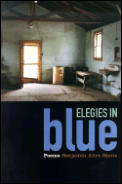
Elegies in Blue


From my dictionary's defintion for elegy:
French élégie, from Latin elega, from Greek elegeia, from pl. of elegeion, elegiac distich, from elegos, song, mournful song.

This third book of poetry (and some prose) by Chicano poet, Benjamin Alire Sáenz is remarkable, beautiful and mournful. It is an astounding, touching and reflective look at life on the El Paso border told by someone who was born and raised there. The book is also an homage to people, from the infamous like Pancho Villa, to Cesar Chavez, to the author’s father-in-law to JFK.

All the work bears the lyrical stamp of Mr. Sáenz. He has a special knack for creating the most simple and beautiful lines on a page. I always find myself stopping to read a certain passage, a stanza again, to read it aloud just to be swept away by the sheer grace and raw power of it. Take for instance this section in his poem What Was It All For Anyway, Cesar Chavez?

“Flattering strategy. You wore that word out Injustice.
It made you sound accusing and superior. Not smart
Cesar, people got nervous. People hated you
Because you spelled it out – one lettuce
At a time.”

In the prose-like American Camps, he speaks eloquently of a boy in a picture he finds in a library, a boy with intelligent eyes, behind barbed wire. He speaks of the hidden histories, obscure ethnic histories.

I loved the poem At the Grave of Pancho Villa. I especially loved the line

“Well better bullets than cancer
for a General.”

My favorite of all the poems and to me, the most strikingly elegiac was The Blue I Loved. It was truly a lovely and haunting in its warm and vibrant imagery.

The poetry in this book is filled with rage, indignation, pride, community, righteous anger and political voice. Any Chicano worth his salt should run over to Cinco Punto’s website and buy it. Don’t just buy it – read it, feel it, love it and then read it again and again.

Wednesday, May 11, 2005

In Perfect Light by Benjamin Alire Saenz


In Perfect Light tells the story of a tormented young man named Andres Segovia and the counselor, Grace Delgado who works to find the source of his torment and rage while at the same time, working through her own torment and issues. As Grace works to save Andres, she saves herself. We meet the most astounding people in this book. There is Mister, Grace’s son, Vicente, Liz and Dave each person searching and finding their own light.

It is a story of how people touch your life, bring sadness, pain or joy to it. Mr. Saenz’ characters are rich and complex, each one’s thoughts and emotions fully illuminated by the intricate tapestry of simple words woven into the most extraordinary sentences.

"They were in a park, and he was studying the look on Liz’s face as she kissed their son. In the light”.

"And then he laughed. His laughter filled the kitchen, then the house. The entire world, it seemed, was filled with this boy’s laugh. And then he let go of Mister’s face, patted his right cheek – and kissed him. “Bendita sea Dios,” Mrs. Rubio whispered.”

These two passages, stuck me as so beautiful in their simplicity, so telling, so rich with wonder that they stopped me, caught me up and blazed with the light of this book. This is a perfect example of what good writing is - to take the ordinary and create something divine.

The book has its dark side as well. We journey to the hell of exploited and abused children of Juarez. We find child molesters seeking new prey and people who look the other way. Benjamin Alire Saenz makes a powerful statement in a gentle, yet powerful way.

I will read this book again and again because of all his books, this is the most exquisite.

BlogBurst.com